

The shift doesn't happen all at once — and that's what makes it so hard to see
There are mornings when everything seems fine. Coffee is made. Conversations flow. Your parent laughs at something on television and for a moment, the worry lifts.
Then there's the other kind of morning. The one where the coffee maker runs with no pot beneath it. Where a familiar name slips away mid-sentence. Where a look crosses your loved one's face — just briefly — that says I don't know where I am right now.
That space between those two mornings is where many families in New Mexico find themselves when they start searching for memory care assisted living. Not because something dramatic happened. But because the quiet moments are starting to add up.
At BeeHive Homes of New Mexico, we understand that space. We've sat with hundreds of families inside it. And the first thing we want you to know is this: noticing the change is not a betrayal. It's an act of love.
The Moments That Make You Wonder
Memory care doesn't usually begin with a diagnosis. It begins with doubt.
A spouse who tells the same story three times at dinner and doesn't realize it. A parent who gets lost driving to the grocery store they've visited for thirty years. A grandmother who calls her grandchild by the wrong name — and the room goes still.
These moments feel small in isolation. But when they begin to cluster, they carry weight.
Families in New Mexico often describe it the same way: "We kept telling ourselves it was just aging." And sometimes it is. But when forgetfulness starts to affect safety — missed medications, a wandering episode, confusion about time or place — it may be time to ask a different question.
Not "Is something wrong?" but "What kind of support would help right now?"
What Memory Care Actually Means
There's a fear around the phrase "memory care" that often comes from misunderstanding.
Many families picture locked wards. Clinical hallways. A world stripped of warmth.
That's not what memory care looks like at BeeHive Homes. Here, memory care is simply assisted living with a deeper layer of awareness. The routines are gentler. The environment is designed to reduce confusion. Staff are trained not just in safety — but in patience, in redirection, in meeting someone exactly where they are.
Meals are still shared at a table. Music still plays. Laughter still happens — often more than families expect.
The difference is in the attention. A caregiver who notices when someone seems lost in thought. A daily rhythm that provides structure without rigidity. A home where repetition is met with grace, not frustration.
That's what separates memory care from standard assisted living. Not walls. Not restrictions. Just a quieter, more intentional kind of presence.
The In-Between Is the Hardest Part
Families across New Mexico — from Rio Rancho to Farmington, from Gallup to Roswell — often describe the same painful limbo: their loved one doesn't seem "bad enough" for memory care, but something clearly isn't right.
That in-between stage is one of the most exhausting places a caregiver can live.
You become a detective — watching for signs, second-guessing yourself, wondering if you're overreacting. You repeat instructions gently. You hide your worry. You lie awake at night running through what-ifs.
Here's what we want you to hear: you don't have to wait for a crisis to seek help.
Early support is not an overreaction. It's the kindest thing you can do — for your loved one and for yourself. Dementia care that begins before a crisis allows the transition to happen gently, with dignity and without panic.
Why Smaller Homes Make a Difference
In a large facility, a resident with memory challenges can feel invisible. Hallways blur together. Faces change shift to shift. Routines feel impersonal.
In a BeeHive Home that offers Memory Care, the setting is intentionally small. Twelve to sixteen residents. Staff who are present every day — not rotating through. A layout that feels like a house, not a building.
For someone navigating memory loss, that smallness is everything. Fewer faces to track. Fewer hallways to get lost in. More moments of genuine recognition — a caregiver who says good morning by name, who knows that your dad likes his coffee black, who remembers that your mom hums a certain song when she's content.
Whether your family is in Bernalillo, White Rock, Edgewood, or Hobbs — that consistency matters more than any amenity list.
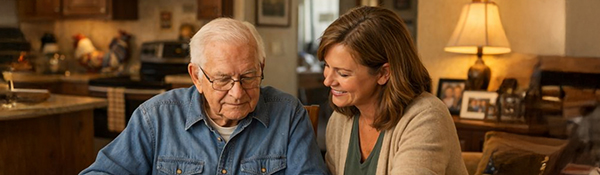
Love Doesn't Forget
Memory care is not the end of someone's story. It's a chapter that deserves the same warmth, respect, and attention as every chapter before it.
A father with Alzheimer's may not remember every name — but he still lights up when his daughter walks through the door. A mother with dementia may struggle with the day of the week — but she still reaches for a hand when a familiar song plays.
Love doesn't require a perfect memory. It lives deeper than recall.
At BeeHive Homes, we protect that. We honor it. And we make space for families to stay connected to it — through visits, through involvement, through the quiet assurance that their loved one is known and cared for.
If you've been searching for memory care assisted living in New Mexico — or simply wondering whether it's time — know that you don't need all the answers to take the first step. You just need to walk through the door.
BeeHive Homes of New Mexico offers memory care and assisted living across the state — from Albuquerque and Santa Fe to Rio Rancho, Farmington, Gallup, Clovis, Deming, Alamogordo, Portales, and beyond. To schedule a visit or ask a question, reach out today.